Categories
Uncategorized

Is EMDR a type of hypnosis?

Is EMDR a type of hypnosis?

Superficially, you can see how EMDR (Eye Movement Desensitisation and Reprocessing) and hypnotherapy are sometimes confused but EMDR is not hypnosis. Hypnosis can be very effective, but it is not a form of psychotherapy like EMDR.

They do share a few core principles:

  • Both involve guided focus:  In EMDR, the focus is on a specific memory while engaging in bilateral stimulation; back-and-forth eye movements, tapping etc. In hypnosis, the focus is on achieving a trance-like state.
  • Both help reframe painful experiences: The ultimate goal of both approaches is to change your relationship with past events or current struggles. They aim to reduce emotional distress and help you develop healthier perspectives and coping mechanisms.

Key Differences Between EMDR and Hypnosis

  • Despite the similarities, the differences between EMDR and hypnosis are significant.
  • Level of Awareness: This is the main distinction. During an EMDR session, you are fully awake, alert, and in control. You are always aware of your surroundings and can stop the process at any time. Hypnosis helps you enter a trance-like state. In this state, your conscious mind relaxes. This makes you more open to suggestions.
  • Conscious vs. Subconscious Work: EMDR mostly engages the conscious mind, while hypnosis guides you into working more with your subconscious.
  • The Therapeutic Process: EMDR uses a specific, eight-phase protocol that includes bilateral stimulation (eye movements, tapping) to help your brain’s natural adaptive information processing system work through traumatic memories. The healing comes from within your own mind’s ability to reprocess. Hypnosis relies on the power of suggestion from the therapist to influence your thoughts and behaviours while you are in a suggestible state.

EMDR vs. Hypnosis: Which Is Right for You?

Choosing between EMDR and hypnosis depends entirely on your personal history, symptoms, and what you are hoping to achieve.

EMDR may be a good fit if you are dealing with:

  • Trauma or Post-Traumatic Stress Disorder (PTSD)
  • Anxiety, phobias, or panic attacks (Works best when a phobia is tied directly to a specific past traumatic event or deep-rooted panic, using bilateral eye movements to reprocess the original memory)
  • Complicated grief
  • Low self-worth or negative self-beliefs tied to past events
  • Feeling “stuck” in traditional talk therapy

Hypnosis might be more suitable if you want to focus on:

  • Changing specific habits (e.g., quitting smoking)
  • Stress reduction and deep relaxation
  • Pain management
  • Addressing certain types of anxiety or phobias (Works best on habit-based triggers, performance anxiety, or simple isolated phobias by entering a focused, relaxed trance state to reframe responses)

It’s always best to discuss your options with a mental health professional who can help you determine the most appropriate path forward.




Categories
Uncategorized

Can I see the same counsellor my friend is seeing?

When you and a friend may be seeing the same counsellor, things to know before you begin

It’s fairly common to find yourself seeing the same counsellor as a friend, especially in smaller communities or specialised practices. While this isn’t automatically a problem, it’s worth understanding the boundary issues involved so you can protect your own therapeutic experience.

Confidentiality works both ways

Your counsellor won’t disclose anything you share, including the fact that you attend sessions, without your consent and the same protection applies to your friend. This means your counsellor generally cannot confirm, deny, or discuss anything about your friend’s sessions, even in casual conversation. Don’t expect any “insider” information, and don’t be offended when none is offered.

Consider how central the friendship is to your own therapy

If it’s a close friendship, one that’s likely to come up often in your sessions (relationship dynamics, shared history, conflicts, or day-to-day life) then it’s generally wisest to see a different therapist. When a friend features heavily in your material, your counsellor’s ability to remain neutral and useful to both of you becomes strained, and you may find yourself editing what you say to protect the friendship or the therapist’s perceived neutrality. In these cases, separate therapists usually serve everyone better.

Avoid comparing notes in ways that create pressure

It can be tempting to discuss what happens in your respective sessions, but this can subtly undermine the process  for both of you. You might feel pressure to perform or “keep up” with your friend’s progress, or feel exposed if your friend later asks the counsellor about something you mentioned.

Your counsellor may take extra precautions

Some practitioners will decline to see two people who know each other closely, precisely because of these risks. Others will proceed but may set clearer ground rules, such as asking each of you not to discuss the other’s sessions, or gently redirecting if either of you brings the other up frequently in session.

If it starts to feel awkward, say so

If you feel inhibited, or worry about things overlapping, raise this directly with your counsellor. They can help you think through whether continuing together is workable or whether one of you switching practitioners might serve you better.

Ultimately, it’s your process

What you choose to share with your friend about your own sessions is up to you, just be mindful that oversharing (in either direction) can blur the lines of what’s meant to be a private, individual space.


If anything here raises questions, please discuss them with your counsellor.

Categories
Uncategorized

Helpful Information and Resources

See below for links to helpful resources —


Categories
Uncategorized

Coping with bereavement and loss

We will all, at some point in our life, experience the death of someone close to us, as well as other losses.

Some losses may be less spoken about in society such as the loss of a baby in pregnancy through miscarriage or abortion.

Other losses bring similar feelings too; the break up of a relationship; loss of health.

Following a bereavement or loss we may experience many powerful, sometimes frightening, feelings such as:

  • Shock
  • Disbelief
  • Numbness
  • Anger
  • Pain
  • Hurt
  • Sadness
  • Guilt and regret
  • Loneliness
  • Despair and depression
  • ReliefYou may find that the bereavement brings other issues to the surface that make it harder to cope.
    Sometimes you may feel that people are wanting you to ‘get over it’ but it is normal for the feelings of grief to come and go over a very long period of time. It is different for everyone.
    Grief also has an effect on our behaviour and how we function. You may find yourself affected by:
  • Sleep problems
  • Loss of appetite
  • Anxiety
  • Finding it hard to cope
  • Feeling restless and irritable
  • Thinking constantly about the person who has died, even imagining you have seen or heard them
  • Loss of interest
  • Tearfulness
  • Exhaustion
  • Physical symptoms such as palpitations, nausea, dizzinessThese are all normal reactions to bereavement and a part of the grieving process.

What can I do to cope with this?

You will need to give yourself time to grieve. Be kind to yourself, these feelings are normal.
There is no right or wrong way to grieve or a set amount of time by which you should be ‘over it’, it is more about finding a way to live with the loss.
Allow yourself to express your feelings, through talking or writing. Listening to music can be helpful.
Keep mementoes of the person. Remembering may be painful at first but will eventually be a comfort and pleasure.
Try to keep up a regular routine of eating, sleeping, exercise and relaxation.
Avoid trying to block your feelings with drugs or alcohol, this only tends to postpone the grieving process.
Take each moment as it comes, don’t think too far ahead and give yourself credit for getting through each day.

I wrote this resource for The Lullaby Trust on Coping with the trauma of sudden bereavement

It’s been a while now and I’m still struggling…

When the normal process of grief does not resolve after many years, it is called “complicated mourning”. With complicated mourning, the impact of the loss may be denied, or you may be frozen in anger, depression, shame or guilt, and unable to make the transition into a peaceful new life.

Talking about how you are feeling can help. You may find it easier to talk to an ‘outsider’ like a counsellor rather than friends or family about how you are feeling.

Sometimes you may be left with a feeling of reliving the events around your loved one’s death particularly if there has been a traumatic incident. A specific therapy; EMDR, can help process these memories. EMDR stands for Eye Movement Desensitisation and Reprocessing. It is a psychotherapy that has been proven to be effective in treating trauma, and is recommended by the UK’s National Institute of Health and Clinical Excellence (NICE) for Post-Traumatic Stress Disorder. Research is showing that EMDR is also effective in facilitating the natural grieving process.
For further explanation about EMDR, click here and here.

Counselling can help ease the pain and loneliness of grief and give you the opportunity to resolve any lingering emotional problems and find more helpful ways of coping. Please contact me to find out how I can help.

Categories
Uncategorized

How can I best help someone who is bereaved?

How to support a bereaved friend or loved one

Please click here to visit the What’s Your Grief website for helpful advice.


What NOT to say to a bereaved person

Please click here to visit the What’s Your Grief website for helpful advice.

Categories
Uncategorized

Why do I need to talk about my childhood?

If you have been in counselling before, you may have been asked about your family or early childhood experiences. Some clients get annoyed by this question, thinking that the past is irrelevant or that therapy is just about blaming their parents for current-day problems. But we are not asking about this to assign blame or to ruminate on the past. Most parents (of course, there are exceptions) have good intentions and are just humans doing the best they are able to. However, the past is present in our daily interactions with others. This is the basis of the Adaptive Information Processing (AIP) model.

What is AIP?
First developed by Dr. Francine Shapiro, the AIP model suggests that the way past experiences were stored in the brain may impact one’s belief about ourself and others. It also suggests that based on these beliefs, people have adapted certain behaviors and attitudes that influence their daily life. During a trauma, the event can become trapped in the emotional part of the brain. If something similar to the original trauma comes up again, this memory gets activated in the same way and can cause the person to apparently overreact or freeze much like they did originally.

Traumatic experiences get stuck in the neural networks with the original perceptions and sensations of the trauma that are triggered by internal or external stimuli. As a result, they become the basis for future unhelpful responses when current events are connected with associated neural networks.

For example, imagine a young child was left at a hospital in the middle of the night due to a medical crisis. Her parents had to leave her and she had this overwhelming sense of abandonment and terror. Because of the stress on her body and the absence of her caregivers, she began to organize her experience to the best of her ability. But she presented with somatic (bodily) symptoms and severe anxiety at any sign of separation from her mother. As she came into adulthood, this and other life experiences continued to shape her fear of abandonment in romantic relationships.

One of the principles of the AIP model is that the failure of unpacking and resolving these stored memories leads to a range of symptoms when the memories are activated. These could include reactions that intrude and lower quality of life. These are called flashbacks.

For that little girl in the hospital, unprocessed childhood trauma was stored with automatic survival reactions of freeze and dissociation (disconnection from feelings) in any situational association with the danger. As an adult, this may not be a helpful reaction in situations which are getting associated with the trauma memory. Through EMDR, she can begin to reprocess these memories and see that the past is truly in the past and that she was not abandoned but had a medical crisis. She can then relate that she no longer needs to fear this same abandonment from her husband or children.

How can it help?
Out of place emotions and negative behaviours that may be bothering a person can be recognised and connected to past experiences.
The model can help uncover exactly what memories trigger the reactions and attitudes one exhibits. With that information, a client and their therapist can use EMDR to process these memories and triggers and transform unhelpful beliefs and perceptions. Isolated memory networks can link up with more adaptive helpful networks so the memory feels in the past and negative self- beliefs are converted to more helpful beliefs.

Categories
Uncategorized

What is EMDR?

EMDR stands for ‘Eye Movement Desensitisation and Reprocessing’.

It was discovered accidentally by Francine Shapiro Phd as she was walking in a park in the late 1980s. As she was walking, She noticed that some distressing feelings she was having about a particular situation suddenly ceased. When she reflected back on what happened, she remembered that she had experienced some spontaneous eye movements (kind of rapid blinking). This led her to experiment further and discover that when thinking and talking about a memory at the same time as stimulating both sides of the brain eg by following hand movements from side to side with the eyes, the distressing memory seems to become less distressing in a long-term way.

Eye Movement Desensitization and Reprocessing (EMDR) therapy is an evidence-based treatment that is used to relieve emotional distress, trauma and pain from the mind and body.

Often, when someone is involved in a distressing or traumatic event, the memory seems to get locked in the nervous system with the original picture, sounds, thoughts, feelings and so on. The brain seems to be overwhelmed and unable to process the experience like a normal memory.

Since the experience is locked there, it continues to be triggered whenever a reminder comes up. It can be the basis for a lot of discomfort and sometimes a lot of negative emotions such as fear and helplessness that we can’t seem to control.

These are really the emotions connected with the old experience that are being triggered.

In EMDR, alternating left-right- bilateral stimulation of the brain with eye movements or sounds or taps is used.

These seem to unlock the nervous system and allow the brain to process the experience. This is similar to what happens in REM or dream sleep: the eye movements may be involved in processing the unconscious material.

Disturbing events can be stored in the brain in an isolated memory network. This prevents learning from taking place. The old material just keeps getting triggered over and over again.

In another part of your brain, in a separate network, is most of the information you need to resolve it. It’s just prevented from linking up to the old stuff. Once processing starts with EMDR, the two networks can link up. New information can come to mind and resolve old problems.

In successful EMDR therapy, the meaning of painful events is transformed on an emotional level. For instance, a rape victim shifts from feeling horror and self-disgust to holding the firm belief that, “I survived it and I am strong.”

Categories
Uncategorized

What happens during EMDR?

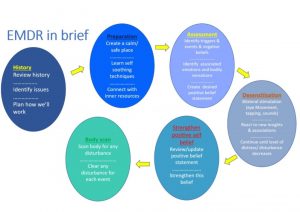
Click to see larger image of Emdr in brief

Your Therapist will spend some time doing some relaxation exercises with you, which could include ‘safe or pleasant place’ exercises, guided visualisation, deep muscle relaxation, breathing retraining, imagining resources etc.
Once you and your therapist feel that you are sufficiently prepared, you can then target a distressing memory with the eye movements or other forms of left-right alternating stimulation, such as sound or taps.

Your therapist will ask you to select an image that represents the distressing event.
You will then be asked to think about negative thoughts in relation to the memory and to think of an alternative positive thought that you would like to believe about yourself.
You will also be asked about your feelings, the amount of distress you feel and where you feel it in your body.

Your therapist will then begin the eye movements while you bring to mind the picture, feelings and bodily sensations and the negative thoughts or beliefs.
The therapist will move their fingers rapidly from side to side while you allow you eyes to follow the movement or may gently tap on either side of your knees or on your hands. While following the movements you allow your thoughts to follow where they need to and just let whatever comes up, come up without censoring.

After each set of eye movements your therapist will ask you what came to mind or what you noticed during the eye movements. During the eye movements you may experience the distressing event quite intensely to start with, but this distress generally reduces as the memory is processed with EMDR. You are free to stop at any time, just raise your hand to indicate you want to stop.

Your therapist will continue with the eye movements until your distress is reduced as much as possible. Your therapist will then ask you to think about your positive thought and also check whether there is any part of your body where you still feel distress. Before the end of the session, your therapist will give you time to feel calm again, using the safe-pleasant place exercise or relaxation techniques.

The important thing to remember is that it is your own brain that will be doing the healing and that you are the one in control.

You might like to watch this Animation explaining what happens in EMDR therapy

Categories
Uncategorized

How will I feel after EMDR?

EMDR treatment generates a certain amount of ‘momentum’ to your thinking and conscious awareness. In other words the treatment does not just stop immediately after your session.
During your eye movement session a lot of memories may come to mind and people find that after the session they may think about these memories. Your therapist will work with you to ensure that you reach a calm place before leaving the session.

It is recommended that you do not do anything too stressful straight after your EMDR session, such as write an exam. You may feel quite tired.
Some people report that after the session they seem to recall more aspects of the events that they hadn’t thought about for a while.

Some report that they dream more. Everybody is different so keep a note of your experience after the session and discuss this with your therapist.
As the distress decreases with EMDR, people report feeling a relief. At the end of EMDR therapy, many people report feeling no distress at all when recalling a distressing event.

Categories
Uncategorized

Resources for EMDR

Container visualisation It can help to visualise an imaginary container to hold distressing material after and in between sessions
Animation explaining what happens in EMDR therapy
Peaceful Place Visualisation
Body Scan Meditation
Progressive Muscle Relaxation
Visualisation of your best future self
Link to several guided meditations- free to download